

UP-TO-DATE, RESEARCH BASED INFORMATION ABOUT PSYCHEDELICS.


Unlocking the self: Can microdosing psychedelics make one feel more authentic?
We propose that feeling and behaving authentically could have a central role in explaining the positive effects of microdosing on health and wellbeing that are reported by current research.

In naturalistic psychedelic use, group use is common and acceptable
Naturalistic psychedelic users are as likely to report an overall positive outcome and no more likely to report adverse events in group settings than in solo settings. This supports further research into PAP in group settings.

Psychedelics in the treatment of eating disorders: Rationale and potential mechanisms
We summarize preliminary data on the efficacy of psychedelic-assisted therapy in people with anorexia nervosa, bulimia nervosa, and binge eating disorder,.
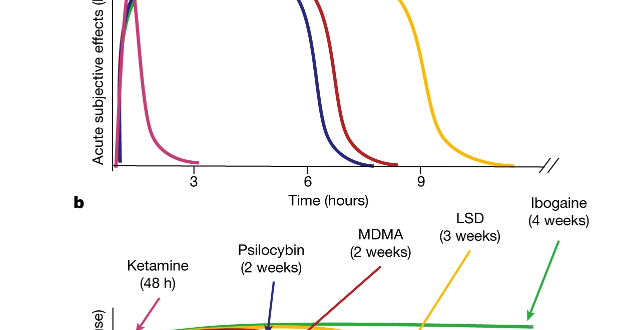
Psychedelics reopen the social reward learning critical period
Notably, the time course of critical period reopening is proportional to the duration of acute subjective effects reported in humans.

Effects of ayahuasca on gratitude and relationships with nature: An open-label, naturalistic study
There was a significant increase in gratitude, nature relatedness, and nature appreciation at the one-week and one-month follow-ups compared to baseline.

Psychedelic therapy in the treatment of addiction: the past, present and future
Evidence is now building for psychedelics' safety and efficacy in treating a range of psychiatric disorders including addiction.


Reports of self-compassion and affect regulation in psilocybin-assisted therapy for alcohol use disorder: An interpretive phenomenological analysis
Our results support the assertion that psilocybin increases the malleability of self-related processing, and diminishes shame-based and self-critical thought patterns while improving affect regulation and reducing alcohol cravings. These findings suggest that psychosocial treatments that integrate self-compassion training with psychedelic therapy may serve as a useful tool for enhancing psychological outcomes in the treatment of AUD.

Cost-effectiveness of psilocybin-assisted therapy for severe depression: exploratory findings from a decision analytic model
Psilocybin has the potential to be a cost-effective therapy for severe depression. This depends on the level of psychological support that is given to patients receiving psilocybin and the price of the drug itself. Further data on long-term outcomes are required to improve the evidence base.

Drug-drug interactions between classic psychedelics and psychoactive drugs: a systematic review
These studies provide insights into the interactions between classic psychedelics and a range of drugs, including antidepressants, antipsychotics, anxiolytics, mood stabilisers, recreational drugs and others.

Extrapharmacological safety topics in psychedelic-assisted psychotherapy
The increasing popularity of psychedelic-assisted psychotherapy (PAP) has generated important discussions about the safety of psychedelic drugs.

Comparative acute effects of mescaline, lysergic acid diethylamide, and psilocybin in a randomized, double-blind, placebo-controlled cross-over study in healthy participants
The results indicate that any differences in the pharmacological profiles of mescaline, LSD, and psilocybin do not translate into relevant differences in the subjective experience.

Phenomenology and therapeutic potential of patient experiences during oral esketamine treatment for treatment-resistant depression: an interpretative phenomenological study
Patients reported several esketamine effects with psychotherapeutic potential, such as increased openness, detachment, an interruption of negativity, and mystical-type experiences.


Changed substance use after psychedelic experiences among individuals in Canada
Participants reported substantial changes, with 43.8% (n = 651/1488) decreasing or ceasing alcohol use, 42.5% (n = 272/640) ceasing or decreasing antidepressant use, and 42.4% (n = 200/471) decreasing or ceasing cocaine use.

Ketamine versus ECT for nonpsychotic treatment-resistant major depression
Ketamine was noninferior to ECT as therapy for treatment-resistant major depression without psychosis.


Applying key lessons from the hospice and palliative care movement to inform psychedelic-assisted therapy
The intention of this commentary is to articulate the deep synergies between hospice and palliative care and PAT.